If It Bleeds, It Leads… to Liability Concerns?: Gonzalez v. Google, Online Terror, and the Need for Section 230 Reform
On November 13th, 2015, extremist terrorists targeted stadiums, concerts, and restaurants across Paris killing 130 and wounding 494 people, including an American student, Nohemi Gonzalez, who was studying at the Strate School of Design in Sèvres for a semester. Under the Antiterrorism Act (ATA), American citizens are given the right to sue for damages caused by acts of international terrorism, and the family of Gonzalez decided to exercise this right, though their suit takes a new approach to that form of liability.
Read More
Overseeing the Overseer: The Unchecked Power of the CFPB
The CFPB, a consolidation of seven federal agencies, currently enforces most regulations related to consumer finance. Enforcing consumer protections often invites broad interpretation, giving the agency extensive power over many economic sectors. The agency issues rules, investigates consumer complaints, supervises entities regulated by consumer protections, and takes enforcement action. This power, it seems, has not come with proportional oversight. While the CFPB is not alone in having unaccountable authority granted by Congress, the bureau’s unique characteristics make its constitutionality dubious.
Read More
The State, Nation, and Genocide: How the UN could apply the Genocide Convention to Russia’s invasion of Ukraine
In justifying Russia’s violent invasion of Ukraine, Russia claims that Ukraine is not a nation — just a part of Russia to be reabsorbed. This denial of Ukrainian nationhood illustrates how the convention on “Genocide” leaves an exploitable, undefined legal ambiguity: Given that the central framing of the Russia-Ukraine war — according to both Russia and Ukraine — is the legitimacy of the Ukrainian people, if Ukraine brought claims against Russia, the argument should reflect attempts to eliminate the Ukrainian state (ie. the government) and therefore the Ukrainian nation (ie. the people). Currently, neither the Convention on Genocide nor Crimes Against Humanity prohibit the elimination of a state in order to annihilate a nation. However, if the state and the nation were explicitly linked, Russia’s denial of and attack on the Ukrainian state could be defined as genocide.
Read More
Article 49.3 in France: A Political Tool
On October 19, 2022, Prime Minister of France Elisabeth Borne invoked the government’s “engagement of responsibility,” ceasing legislative debate over the state budget in the National Assembly (l’Assemblée nationale). Less than 24 hours later, Borne triggered the provision once again, this time for the Social Security finance bill (PLFSS). In response, the second and third largest political groups in Parliament—the left-wing Nouvelle Union Populaire Écologique et Sociale (NUPES) coalition and the right-wing Rassemblement National (RN)—filed motions of no confidence, which would ultimately end up rejected by the majority of Parliament.
Read More
New York Civil Court Judge Breaks Precedent Regarding Polyamorous Relationships
The Civil Court of the City of New York’s Judge, Karen May Bacdayan, broke precedent last year in her ruling that polyamorous partners, called “non-traditional” family members, should not automatically be denied legal rights. On September 23, Judge Bacdayan held in West 49th St., LLC v. O’Neill that the third partner, respondent Markyus O’Neill, to married couple Scott Anderson and Robert Romano was allowed to renew a lease in Anderson’s name. In the United States, the rights of polyamorous couples are confusing and seemingly non-existent; however, the general consensus is that the married spouses retain legal rights that the other partners do not receive. Therefore, Judge Bacdayan’s ruling in West 49th St., LLC v. O’Neill could have a dramatic impact on future polyamorous relationship case law if recognized by upper courts both on a state and federal level, having the potential to set a precedent on an otherwise legally unrecognized group.
Read More
Terminations of the Paramount Decrees: A Greenlight for Monopolies
In August 2020, during the height of the COVID-19 pandemic, New York federal court terminated the Paramount Consent decrees. The federal court’s termination of these decrees suggests the idea that they have little to no effect in regulating the current market despite the recent conglomerations of streaming services. This calls into question the purpose of terminating “legacy” antitrust judgments that seemingly have no present-day ramifications.
Read More
Where Creativity and Copyright Collide: AWF v. Goldsmith and the Fight Over Fair Use
On October 12, 2022, the Supreme Court heard oral arguments in Andy Warhol Foundation for the Visual Arts, Inc. (AWF) v. Goldsmith, a case that could become the most consequential copyright infringement dispute in decades. Goldsmith owes its significance to its focus on the (admittedly elusive) standard of artistic “transformativity,” which has so far led the court to consider the transformative qualities of art ranging from Mork and Mindy to the Mona Lisa, Lord of the Rings, and, somehow, Syracuse University football games. It is the first non-digital fair use case the Court has heard in nearly 30 years and concerns a series of 16 Andy Warhol portraits of the late musical icon Prince, the inspiration for which came from a 1984 headshot by music photographer Lynn Goldsmith. Goldsmith alleges that Warhol, in creating art that existed outside of a prior licensing deal she had with the magazine Vanity Fair, violated the copyright of her work. AWF, who currently owns the rights to Warhol’s work, argues instead that the transformative nature of the paintings qualify them as fair use.
Read More
A Conservative Supermajority on the Supreme Court and its Impact on Affirmative Action
With the Supreme Court’s recent decision in Dobbs v. Jackson’s Women’s Health Organization (2022), where five Supreme Court justices voted to overturn the precedent set by Roe v. Wade (1973), the Court demonstrated a willingness to question, and even overturn, past precedent. Among the contentious cases for this term is Students for Fair Admissions v. President and Fellows of Harvard College, a case concerning affirmative action and discrimination in the college admissions process. Students for Fair Admissions will be the first affirmative action case the Court has decided since it largely upheld the use of race as a factor in college admissions decisions in 2016. However, the current makeup of the Court, of which three Trump-appointed justices have cemented a conservative supermajority, likely represents the end of the constitutionality of affirmative action, with Students for Fair Admissions being a key case in overturning past precedent.
Read More
Limits to the Scope and Enforceability of U.S.-Russia Sanctions
On February 22, 2022, the Office of Foreign Assets Control (OFAC)’s issuance of the related Directive 1A under the Executive Order on Blocking Property (EO 14024) pioneered a series of sanctions impacting various entities (notably commercial) under U.S. jurisdiction. In the spring of 2022, the Special Russian Sanctions Authority Act of 2022 was introduced in the Senate and ultimately signed into law, legalizing the expansion of the existing sanctions against the assets of Russian political elites since the onset of the Russia-Ukraine war. In analyzing the application of U.S. contract law, professional codes of conduct for U.S. attorneys, and the limits of U.S. jurisdiction as it concerns these government sanctions, one may discover limitations to the long list of sanctions against Russian entities and their enforceability.
Read More
Paradox or Contradiction? Antitrust Law in Labor Markets
Earlier this year, the Federal Trade Commission (FTC) and Justice Department (DOJ) launched a joint inquiry investigating the “impact of monopsony power, including in labor markets.” While monopoly describes a single producer or group thereof manipulating a market, monopsony is the condition of a single buyer doing the same. To conceptualize monopsony in labor markets, think of the “Company Town.” A single firm employs all or most workers in a town. The firm has no competition when hiring townsfolk. The townsfolk do not have an alternative venue for employment. This allows the firm to set wages with minimal to no negotiation as the sole buyer of labor, behaving as a monopsony. In labor markets, workers supply while firms purchase labor. Yet, there is reason to think that recent antitrust developments by the FTC will be another lame duck in Washington.
Read More
Divided We Fall: How Two Upcoming Supreme Court Cases Threaten to Derail Democracy
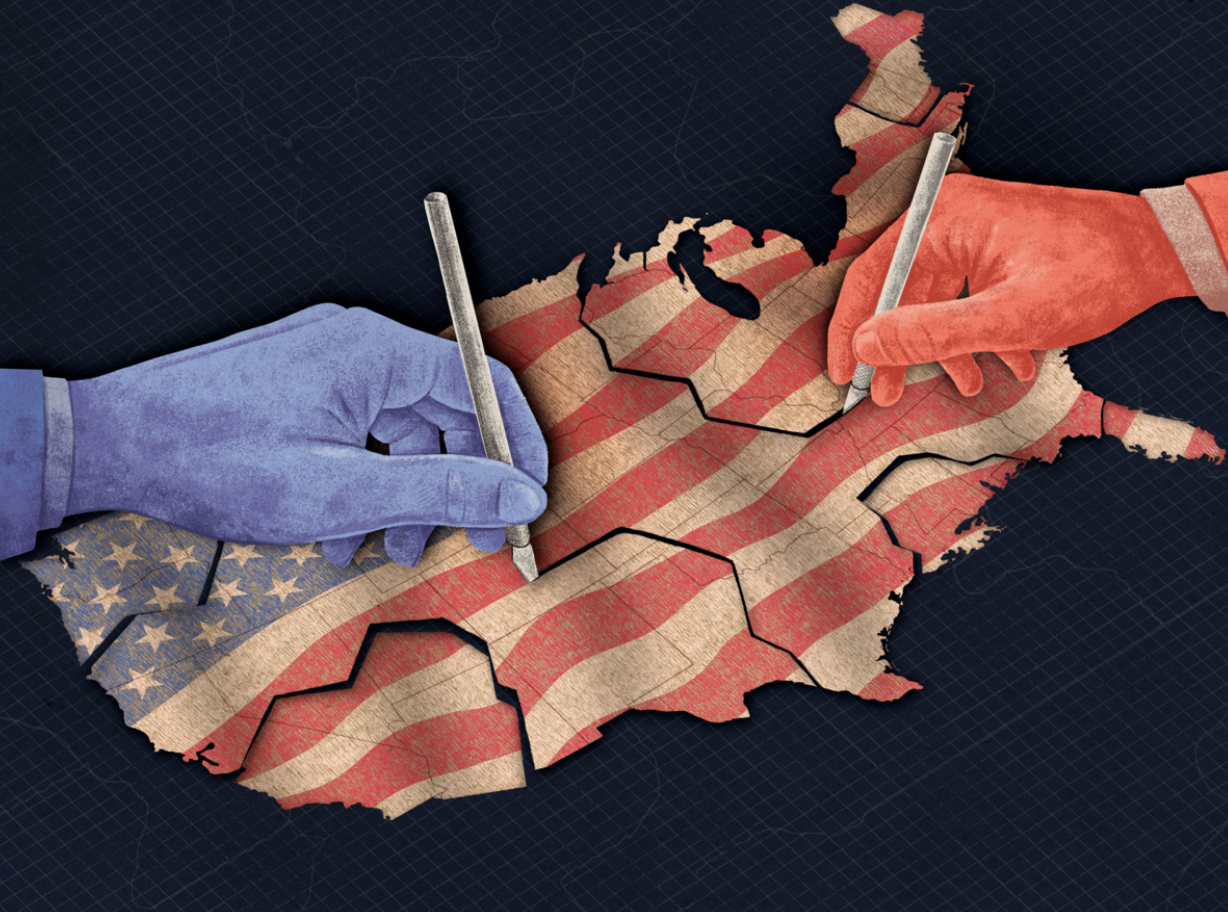
In just a few months, the Supreme Court will issue decisions on two pivotal cases that will determine the course of democracy in the United States. The challenges to voting rights presented in these cases threaten to diminish the voting power of large swaths of voters by potentially allowing for more gerrymandered congressional maps and giving states nearly unchecked regulatory power over elections, undermining an election system that should be impartial and democratic.
Read More
It’s Time We Defend the First Amendment on Social Media
Traditionally, the First Amendment has protected speech in public spaces. But when virtually all political expression takes place on privately owned forums, it becomes a governmental duty to defend that fundamental right when it is threatened, whether that be in the streets and in parks or on the internet. When Twitter disabled then-president Donald Trump’s account following the 2021 Capitol riot, reactions were mixed across the political spectrum. While some praised the move as responsible content moderation, others condemned it as just one instance among many of anti-conservative bias on social media platforms. Yet there was one thing everyone could agree on: the debate over the role of social media in politics was only just beginning.
Read More
Perpetuating Poverty: How Payday Loan Companies Take Advantage of Vulnerable Consumers
Jason Stinnett, a bankruptcy and consumer litigation attorney at a non-profit law firm in downtown Baton Rouge, Louisiana, is familiar with the devastating impacts of predatory payday lending. His clientele are mostly Black women, many of whom support families on less than $1,500 a month. To pay for basic living expenses like rent and groceries, some borrow from local consumer finance companies. It is easy to accumulate debt from these loans, but hard to escape it. The interest rates on payday loans in Baton Rouge can reach higher than 33%, and it is not uncommon for companies to sue borrowers for debts that amount to more than their yearly income.
Read More
Error 404: Digital Humanitarianism and the Mirage of Human Rights
In a period of increased state violence, geopolitical conflict and environmental catastrophes, there is a newfound urgency to improve the efficiency of humanitarian aid. As with most challenges in the twenty-first century, governments and organizations have turned to technology to address these issues. However, there is nothing inherently progressive about big data, and when examining its humanitarian consequences, big data collection threatens to undermine existing international human rights law (IHRL), namely; the right to privacy and equality.
Read More
International Criminal Court Jurisdiction Over ISIS Leaders
In early July 2022, the U.S. military killed the top Syrian leader of the Islamic State of Iraq and Syria (ISIS) in a drone strike in northwestern Syria. While the U.S. has continued to destroy ISIS militarily, many international observers have called for the prosecution of certain ISIS leaders before the International Criminal Court (ICC). ISIS, as well as other major terrorist groups, has committed acts that seem to fall under the international law definitions of crimes against humanity, or even genocide, which are among the crimes that the ICC prosecutes.
Read More
Plea Deals: An Unconstitutional Bandaid for our Overburdened Justice System
Plea deals are like contracts; the defendant agrees to plead guilty in exchange for a more moderate sentence or for certain charges to be dropped. [1] Prosecutors are eager to offer this deal because it allows them to avoid taking the defendant to trial, a process that requires time and money. While this seems like a mutually beneficial process, in reality the plea deal system as it currently exists is unconstitutional because defendants are often coerced into pleading guilty and are required to waive key constitutional rights in the process.
Read More
State Secrets: How A Recent Supreme Court Decision Could Limit Judicial Independence
On March 3, 2022, the U.S. Supreme Court ruled against suspected terrorist Abu Zubaydah in United States. v. Zubaydah, declaring the U.S. government could invoke an evidentiary rule called the state secrets privilege to withhold evidence related to his torture in the name of national security. [1] This decision will have significant repercussions for the balance of power between different branches of the American government. An example of excessive judicial deference, the ruling could lead to a significant expansion in executive influence over judicial proceedings. Crucially, such expansion could provide a basis for selective governmental accountability and consequently threaten individual access to justice.
Read More
Brackeen v. Bernhardt and the Future of Adoption in the United States
A three year old boy might be responsible for the transformation of a U.S. child welfare law aimed at protecting Native American culture and rights throughout the adoption process. The Indian Child Welfare Act of 1978 (ICWA), which was enacted by Congress in response to a crisis of separation amongst Native families, is set to be evaluated by the Supreme Court in October. [1] If this term’s Supreme Court decides to rule the Act unconstitutional, this decision would dismiss some tribal sovereignty over the adoption processes and would devastatingly exacerbate the marginalization of Native peoples.
Read More
Originalism, Dobbs, and the Unconstitutionality of Roe
In 2018, Mississippi passed the Gestational Age Act, which banned abortion after 15 weeks with only narrow exceptions. [1] Jackson Women’s Health Organization, the only licensed abortion provider in the state, challenged the law in a federal district court. [2] The district court struck down the Mississippi law, and the U.S. Court of Appeals for the Fifth Circuit upheld the lower court’s decision. [3]
Read More
Critical Race Theory and Human Right Education: Where Domestic and International Concerns Meet
Throughout 2021 and 2022, legislators across the country banned Critical Race Theory from being taught in elementary, high schools, and public universities. In Oklahoma, House Bill 1775 banned conversations on race and gender that deal with implicit bias or the systemic effects of racism and sexism in America. Non-discrimination and examination of prejudice are essential to CRT to increase students’ awareness of their own rights, especially those that have been historically withheld, and spur discussion on respecting others’ rights. These principles are evident in the Human Rights Education and Training Treaty (HRET), and can be used as a mechanism to pressure the United States to uphold its agreement to the promotion of human rights through CRT. [1]
Read More