
The Illusion of Equity: Why “Ability to Pay” Mandates Require Standardized Bail Guidelines
The use of bail has been heavily contested and reshaped across the United States since the late 2010s. At the heart of this debate is one main point of contention: whether judges should consider a defendant’s “ability to pay” when setting bail amounts. Tennessee and New York represent the opposite ends of the bail reform spectrum, and a comparison between the two demonstrates that neither approach has been able to properly address the issue’s constitutional premise. While Tennessee recently mandated that judges disregard financial status, New York has moved in the exact opposite direction.
In May 2024, the state of Tennessee passed House Bill 1719, which explicitly “prohibits a magistrate from considering a defendant's ability to pay when determining the amount of bail.” Though many states have yet to voice an opinion on such considerations, this bill makes Tennessee the only state in the nation to definitively prohibit them. Conversely, New York’s 2019 Senate Bill S7506B effectively overhauled the state's bail system entirely. The bill eliminated the ability to set bail on most misdemeanor and non-violent felony charges, and most notably, required that judges, when setting bail, consider the “principal’s individual financial circumstances, and … ability to post bail without posing undue hardship.”
Though the scope of New York’s bail moderation situates it as an interesting case study, it should be noted that it is not alone in its approach. Additional states such as Nevada and California have also mandated financial considerations, grounded in the argument that setting bail without consideration of a defendant’s “ability to pay” was in violation of the Fourteenth Amendment's due process and equal protection clauses. Specifically, both states relied on Bearden v. Georgia (1983) as precedent for their aforementioned due process and equal protection applications.
In Bearden v. Georgia (1983), the U.S. Supreme Court held that “if a State determines a fine or restitution to be the appropriate and adequate penalty for the crime, it may not thereafter imprison a person solely because he lacked the resources to pay it”—instituting that courts must consider a defendant's “ability to pay” when retracting probation due to unpaid court fines. Furthermore, the Court stated that acting in opposition to this would “be contrary to the fundamental fairness required by the Fourteenth Amendment."
Although Bearden addressed a different stage of the legal process, namely revocation of probation rather than pretrial bail, both California and Nevada used the precedent set forth in Bearden v. Georgia to conclude through In re Humphry (2021) and Valdez-Jimenez v. Eighth Judicial District Court (2020) respectively, that judges must consider a defendant's ability to pay when deciding bail amounts. Essentially, these determined that the underlying constitutional concern of detaining an individual solely based on their financial status was the same, regardless of the procedural stage of the detention. California’s Supreme Court even went as far as to definitively state that “conditioning freedom solely on whether an arrestee can afford bail is unconstitutional.”
If conditioning freedom solely on ability to afford bail is deemed unconstitutional, then the logical corollary is that judges have a way to meaningfully assess “ability to pay”. Yet both In re Humphry, and Valdez-Jimenez fail to prescribe exactly how defendants’ financial status is to be determined, as well as how much magnitude it should be allotted once determined. While the constitutional mandate is clear, its implementation remains rather vague, leaving its application up to individual judge’s discretion, and consequently creating a path for disparate and unjust sentencing — recreating due process violations, instead of resolving them.
As of July 2024, Bearden v. Georgia is being used to argue for consideration of “ability to pay” once again—this time in an effort to repeal Tennessee’s unprecedented House Bill 1719. Following the implementation of the bill, Just City, Inc., a Tennessee based non-profit, along with the ACLU, filed a suit against Shelby County, Tennessee judicial officials. The plaintiffs are challenging the bill on Fourteenth Amendment grounds arguing that the bill allows for discriminatory enforcement. The suit was amended to a class action in December 2025 and now includes all individuals in the custody of the Shelby County Sheriff who are detained under bail orders pursuant to the bail statute as amended by House Bill 1719. While a preliminary injunction on the new bill was denied—maintaining its current effect—the court also denied motions to dismiss, with the case set to proceed to a full trial.
These simultaneous decisions hinged on the court’s belief in both the relevance of the plaintiffs’ Bearden argument, as well as its limitations. In denying the State of Tennessee’s motions to dismiss, the court concluded that if the bail orders under the new bill were “unconstitutional as wealth-based detentions” — as suggested by case law such as Bearden — then the plaintiffs had a plausible claim for relief in their constitutional challenge. However, the court denied the plaintiff's motion for a preliminary injunction. It acknowledged that while it recognizes the precedents set forth in Bearden, the Supreme Court has not explicitly extended them to pretrial bail proceedings “although it may be logical to do so.” Accordingly, the court concluded that a high likelihood of success based on the merits of these precedents alone — the finding necessary to grant a preliminary injunction — had not yet been established.
Under Bearden, In re Humphry, and Valdez-Jimenez, the constitutional concern is that defendants are detained based on wealth rather than risk. Analysis of 2025 arraignment data collected by the New York Criminal Court parts (comprising 96,533 data points) reveals differences across judges in the five boroughs. Such differences, among presumably similar defendant pools, implies that the “ability to pay” mandate is not fulfilling its purpose as a meaningful constitutional safeguard. Instead, it is inadvertently functioning as a pass for judicial inconsistency.
Though the current emphasis on maintaining due process and equal protection through the directive of “ability to pay” is pertinent, the ambiguity of its application echoes the need for more concise and clear rulings. Without a standardized method mandating how a defendant’s financial status is to be determined, or how to weigh said status against other factors, outcomes remain highly dependent on individual judges’ discretion.
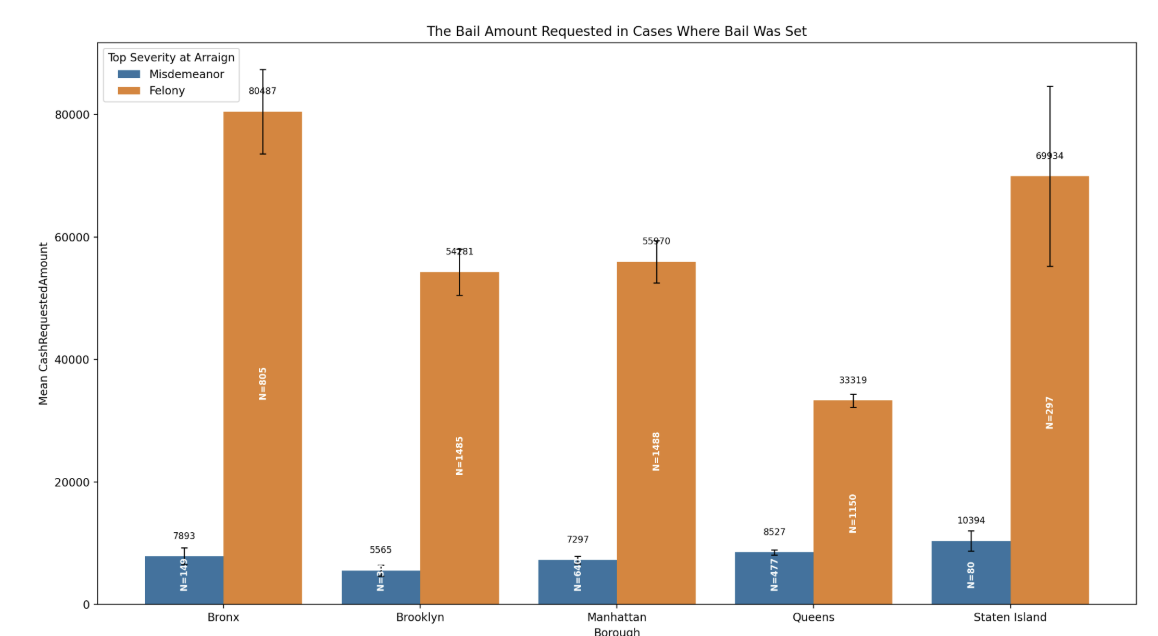
Figure 1
Figure 1 presents bail amounts set in the five New York City boroughs, among cases where bail was set, and compares it to the amounts requested by each District Attorney (DA). The results indicate that on average, the quantity requested in Queens was far smaller than the other four boroughs, with the quantities requested in the Bronx and Staten Island holding at roughly twice as high.
While this could be driven by a myriad of factors such as differing charges, failures to appear, and even financial situations, it still showcases immense differences in the determination process of bail between the boroughs.

Figure 2
Figure 2 depicts the share of bail set—the percentage of the DA’s requested amount that the judge ultimately grants. When comparing the boroughs, these results suggest that judges in different boroughs react differently to their designated DA.
Since there is no established guidelines for evaluating the different factors given to judges in New York City that determine “ability to pay” (income, employment status, dependants, etc.), or for evaluating its importance in comparison to other case variables, there is no way to definitively decipher if judges are adjusting bail amounts based on the defendant's finances or as a reaction to their local DA’s requests.
Beyond this, if DAs consider “ability to pay” before requesting bail amounts, then the variance seen in judge grants in Figure 2 could showcase the ambiguity of the current legal framework, displaying the need for guidelines regarding how and at what magnitude judges should consider “ability to pay” in order to avoid randomness in sentencing.
Finally, since the main point of interest in regards to “ability to pay” is income and assets, the most relevant comparison would be between judges in the same borough. There is no way to perfectly conduct such a comparison as arraignment cases within each individual judge’s docket naturally vary. However, judges do hold arraignment proceedings on a rotation. So, it would be reasonable to presume that defendants’ average income and the DA’s request method, within the same borough, would be relatively uniform. Thus, leading to the assumption that variances between judges that operate within the same borough would not vary significantly.
Yet, the analysis of the data shows that even within the same borough, with the same DA and with no reason to assume by-judge variation in defendants' income, there are still differences in the quantities of bail judges set. While this data alone does not unconditionally indicate that judges are arbitrarily or randomly applying the “ability to pay” mandate, the degree of intra-borough variation is difficult to explain if judges are applying a consistent standard. The most plausible explanation is that in the absence of standardized guidelines, individual judicial discretion is driving outcomes—even in states that are actively attempting to eliminate sentencing disparities.
In order to properly address the Fourteenth Amendment due process and equal protection clauses that were set forth in Bearden v. Georgia and used to validate the implementation of “ability to pay” mandates, there must also be legislation that establishes guidelines and precedent regarding how “ability to pay” is determined, as well as the magnitude judges should accord it. Absent these guidelines, “ability to pay” mandates make room for the recreation of the exact due process violations they seek to avoid.
Edited by Uma Rajan.
This piece was reviewed and finalized by Gabi Fabozzi, Qizhen (Kiara) Ba, and Jasmine Lianalyn Rocha.